2026-09-09
Post-Glaucoma Surgery Care: Why Can the Optic Nerve Still Deteriorate Even with Normal Intraocular Pressure?
Understand why diligent post-glaucoma surgery care and regular OCT and visual field testing are essential to prevent optic nerve damage even when intraocular pressure is normal.


Without proper post-glaucoma surgery care, optic nerve damage can silently progress even if intraocular pressure (IOP) remains within a normal range. It is only natural to feel relieved when you are told that surgery went well, but with glaucoma, surgery is actually just the beginning of lifelong management. Because optic nerve damage cannot be reversed with current medical science, preserving your remaining visual field is the core objective of treatment.
Today, let's explore why post-glaucoma surgery care is so vital and examine specific steps you need to take.
1. How does post-operative care differ depending on the type of glaucoma surgery?

Post-glaucoma surgery care varies depending on the specific procedure performed. Currently, glaucoma surgeries are broadly categorized into three main approaches.
Trabeculectomy creates a new drainage pathway inside the eye for aqueous humor to escape. It is primarily used for advanced glaucoma where IOP must be significantly lowered. After surgery, the key priority is monitoring the condition of the filtering bleb. If the bleb scars and heals excessively, the drainage path may become blocked, causing IOP to rise again. Regular follow-up checkups assess bleb shape and function, and procedures like bleb needling may be performed if necessary to release adhesions.
An Ahmed valve implant involves inserting an artificial shunt device into the eye to facilitate aqueous humor drainage. It is frequently utilized in refractory cases, such as neovascular glaucoma, or when IOP remains difficult to control following prior surgeries. Postoperatively, fibrosis can form around the drainage plate, or the tube may shift, making it essential to monitor both device integrity and pressure fluctuations.
A XEN gel stent procedure is a minimally invasive approach that inserts a microscopic gel tube to establish a drainage outflow path. Because it requires a smaller incision and allows faster recovery, it is often considered for mild to moderate glaucoma. However, because the tube is very fine, fibrosis can lead to blockage. Post-operative anti-fibrotic treatments and close observation are required to verify that drainage function is well maintained.
Regardless of the chosen surgical method, diligent aftercare is universally needed. However, since the specific points requiring attention vary as outlined above, it is best to establish a tailored management plan together with your eye specialist based on your specific procedure.
2. Why does intraocular pressure fluctuate right after surgery?
It is completely natural for intraocular pressure to temporarily fluctuate after surgery as aqueous humor drainage rates and ocular tissue responses continuously shift. In particular, during the first few days to weeks following surgery, cellular reactions and wound-healing processes are highly active, requiring meticulous monitoring.
If IOP remains excessively low, it can compromise the retina or choroid; conversely, a sudden spike in pressure can diminish surgical success. Complications such as bleeding, inflammation, and endophthalmitis must also be assessed during this window, making timely visits to the clinic strictly on schedule indispensable.
3. Why are continuous checkups necessary even when intraocular pressure is normal?
A normal intraocular pressure reading is generally considered to be 21 mmHg or lower. However, among East Asians including Koreans, the proportion of normal-tension glaucoma (NTG)—where the optic nerve suffers damage despite pressure within the normal range—is remarkably high.
In fact, the Namil Study, a domestic epidemiological survey, reported that approximately 77% of open-angle glaucoma patients in Korea had normal-tension glaucoma with an IOP of 21 mmHg or lower. In other words, you cannot let your guard down based solely on pressure readings.
There are indeed cases where OCT scans reveal progressive thinning of the retinal nerve fiber layer, or visual field exams show expanding blind spots even under normal pressure. This is precisely why pressure measurements must always be evaluated in tandem with the actual structural and functional health of the optic nerve.
4. What types of glaucoma eye drops exist, and how do they differ?

Eye drops may still be utilized as part of ongoing treatment following glaucoma surgery. These drops are classified based on their mechanism of action.
Beta-blockers: Reduce aqueous humor production to lower IOP. A consultation is mandatory before use for individuals with heart conditions or asthma.
Prostaglandin analogs: Enhance aqueous humor outflow. Their sustained effect from a single daily drop makes them a first-line therapy for many patients.
Alpha-2 adrenergic agonists: Suppress aqueous production while partially increasing uveoscleral outflow. They are frequently used in combination with other drops.
Carbonic anhydrase inhibitors: Inhibit the enzyme responsible for aqueous humor synthesis. Available in both topical drops and oral formulations.
Rhopressa (Netarsudil): A newer agent that lowers resistance across the trabecular meshwork to optimize conventional outflow. It serves as a modern alternative when standard medications prove insufficient.
5. If pressure has stabilized, do I still need to use glaucoma drops?
Patients occasionally discontinue their glaucoma drops arbitrarily once their pressure appears stable. However, drops prescribed post-surgery do not solely control pressure. They also serve critical functions in suppressing inflammation, preventing infection, and curbing excessive tissue scarring around the surgical site.
The frequency and duration of administration vary by individual patient condition and must strictly follow the ophthalmologist's instructions. If severe redness, eye pain, or visual decline occurs after instilling drops, seek immediate medical attention.
6. What daily precautions must be followed after surgery?

During the initial recovery phase, avoiding any actions that place physical stress or pressure on the eye is essential. Rubbing the eye forcefully can irritate the surgical wound and compromise the filtering bleb. Repeatedly lifting heavy items, bending the head down for prolonged intervals, or performing intense resistance training can transiently spike intraocular pressure and must be restricted for a specified period.
When sleeping, wearing the protective eye shield recommended by your physician will safeguard the operative eye against unintentional compression.
7. Which diagnostic tests are mandatory during routine follow-ups?
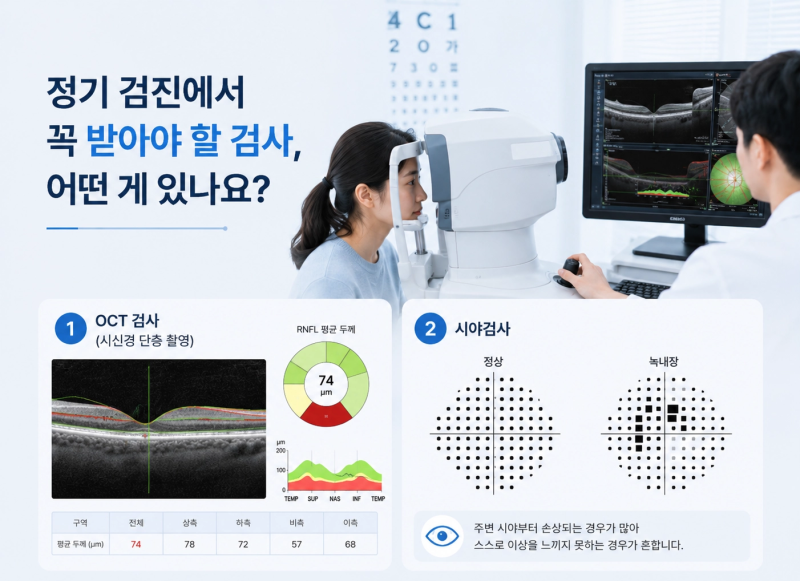
① OCT Scan (Optical Coherence Tomography)
This exam measures thickness changes in the retinal nerve fiber layer down to the micrometer level. It can detect subtle nerve thinning long before a patient perceives any subjective symptoms.
② Visual Field Test
A functional examination that determines whether the perimeter of your vision is narrowing. Because glaucoma characteristically erodes peripheral vision first, patients rarely detect abnormalities on their own in the early stages. The American Academy of Ophthalmology (AAO) clinical guidelines strongly recommend regular automated visual field testing, noting that visual field defects can continue to advance even after pressure is safely reduced post-surgery.
Frequently Asked Questions After Glaucoma Surgery
Q1. Surgery is done—when can I start working out again?
Light walking can be resumed relatively soon, but workouts that increase intra-abdominal pressure—such as heavy weightlifting or strenuous hiking—should be phased in gradually only after consulting your doctor.
Q2. What about coffee and alcohol?
Caffeine can transiently elevate intraocular pressure, and alcohol consumption can alter eye drop absorption and eye hemodynamics. It is wise to refrain from both for a designated recovery period after surgery.
Q3. Does prolonged smartphone use worsen glaucoma?
While there is no direct evidence that prolonged near-screen viewing accelerates glaucoma progression, adopting habits that alleviate eye fatigue and allow ample rest remains important for general ocular wellness.
Following glaucoma surgery, consistent evaluation of both IOP and optic nerve health is essential, with adjustments in eye drop regimens or supplementary interventions performed as necessary.
At St. Mary's Jin Eye Center, diagnostic care is personally led by a board-certified ophthalmologist who serves as a Korean Ophthalmological Society instructor and clinical adjunct professor at the Catholic University of Korea College of Medicine. We rigorously evaluate each patient's condition using comprehensive tonometry, high-resolution OCT, and visual field testing. Through systematic post-operative monitoring and personalized management, we vigilantly track pressure changes and the progression of optic nerve health.
If you wish to preserve your precious sight for years to come, begin by scheduling your regular checkup.
Key Takeaway!
Post-glaucoma surgery care is just as critical as the procedure itself. Because optic nerve deterioration can progress even under normal pressure, consistent routine examinations are essential.
Curious about the early warning signs of glaucoma, self-check techniques, and management strategies? Read more in the related article below.