2026-09-15
Allergic Conjunctivitis? How to Distinguish Eye Conditions for Those with Itchy, Red Eyes Every Seasonal Change
Understand how to differentiate allergic conjunctivitis, dry eye syndrome, and epidemic keratoconjunctivitis during seasonal changes, along with proper care.

Eye itching, redness, and stinging: treatments vary depending on the cause. Learn how to distinguish between allergic conjunctivitis, dry eye syndrome, and epidemic keratoconjunctivitis based on symptoms.
During the transitional seasons of spring and autumn, many people experience increased eye discomfort. This occurs because external particles such as pollen, yellow dust, and fine dust surge rapidly, while indoor air becomes dry due to heating and air conditioning, exposing the ocular surface to double the irritation. When the conjunctiva reacts hypersensitively to specific substances during this time, it can lead to allergic conjunctivitis.
Simply put, an inflammatory reaction occurs in the eye because the body mistakenly identifies harmless substances like pollen or house dust mites as "dangerous." Consequently, itching, redness, increased tearing, and conjunctival swelling (chemosis) appear simultaneously. In particular, individuals prone to seasonal allergies often experience nasal symptoms (runny nose, sneezing) alongside eye symptoms, frequently following a recurring pattern around the same time each year.
For those dealing with these issues, this article explains how to differentiate allergic conjunctivitis from dry eye syndrome and epidemic keratoconjunctivitis, as well as how to manage each condition effectively.
Seasonal Eye Itching: Is It Allergic Conjunctivitis or Dry Eye Syndrome?
[Key Summary]
Category | Allergic Conjunctivitis | Dry Eye Syndrome | Epidemic Keratoconjunctivitis |
Key Symptom | Severe, unbearable itching | Stinging, gritty foreign body sensation | Redness, photophobia, gritty feeling |
Onset Pattern | Usually both eyes simultaneously | Gradual onset in both eyes | Starts in one eye → spreads to the other soon after |
Discharge | Stringy, mucous discharge | Minimal to none | Watery, thin tears |
Contagiousness | Non-contagious | Non-contagious | Highly contagious |
Cause | Hypersensitive immune response to allergens | Insufficient tear volume or poor tear quality | Adenovirus infection |
1. If You Have Unbearable Itching, It Is Likely Allergic Conjunctivitis
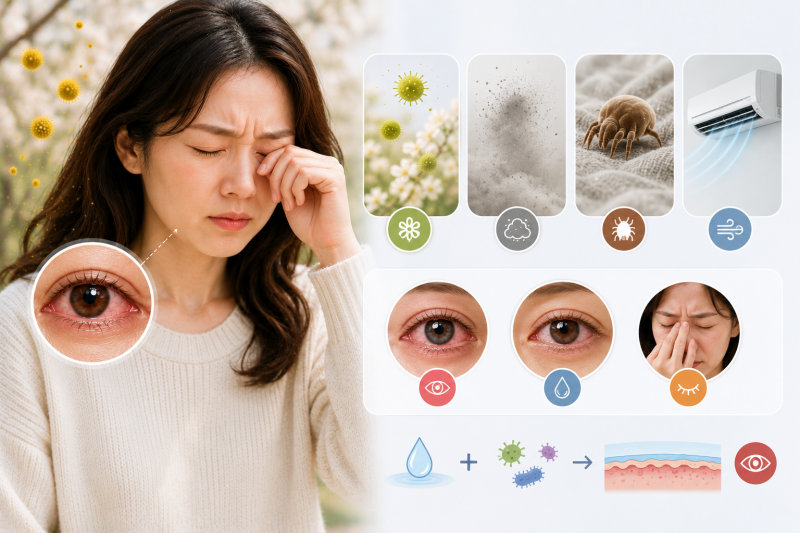
The most distinctive sign of allergic conjunctivitis is 'unbearable itching.' Unlike redness caused by fatigue, it triggers a strong urge to constantly rub the eyes. According to the Korea Disease Control and Prevention Agency (KDCA), major symptoms include:
Severe itching — Usually appears in both eyes simultaneously and intensifies when overlapping with seasonal allergy triggers.
Redness (Hyperemia) — Redness develops due to conjunctival inflammation and does not easily subside even after adequate rest.
Excessive tearing — Tearing increases as a protective response to irritation and tends to worsen in windy or dry environments.
Eyelid swelling (Edema) — When inflammation is severe, eyes may be swollen in the morning or experience fluctuating swelling throughout the day.
Mucoid discharge — Sticky discharge forms, though in smaller quantities compared to bacterial conjunctivitis.
Associated allergic rhinitis — Often accompanies nasal congestion and a runny nose; treating rhinitis concurrently is known to relieve eye symptoms as well.
2. If Stinging and Grittiness Are More Prominent, It May Be Dry Eye Syndrome
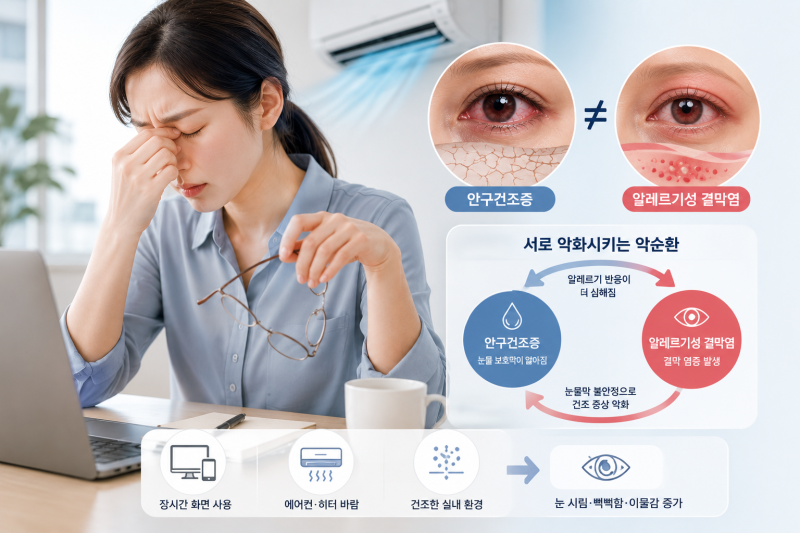
If stinging, foreign body sensation, and grittiness are more pronounced than itching, dry eye syndrome is more likely. Dry eye syndrome refers to a condition where the tear volume decreases or the balance of tear film components is disrupted, preventing the ocular surface from remaining adequately lubricated. Symptoms characteristically worsen during prolonged screen time or direct exposure to air conditioning or heating.
The reason allergic conjunctivitis and dry eye syndrome are often confused is that they exacerbate each other. Dry eye syndrome thins the protective tear film, making allergic conjunctivitis occur more frequently and severely.
Conversely, conjunctival inflammation can destabilize the tear film, aggravating stinging and dryness. In clinical practice, many patients present with both conditions simultaneously.
3. If Redness Is Accompanied by a Gritty Foreign Body Sensation, Suspect Epidemic Keratoconjunctivitis
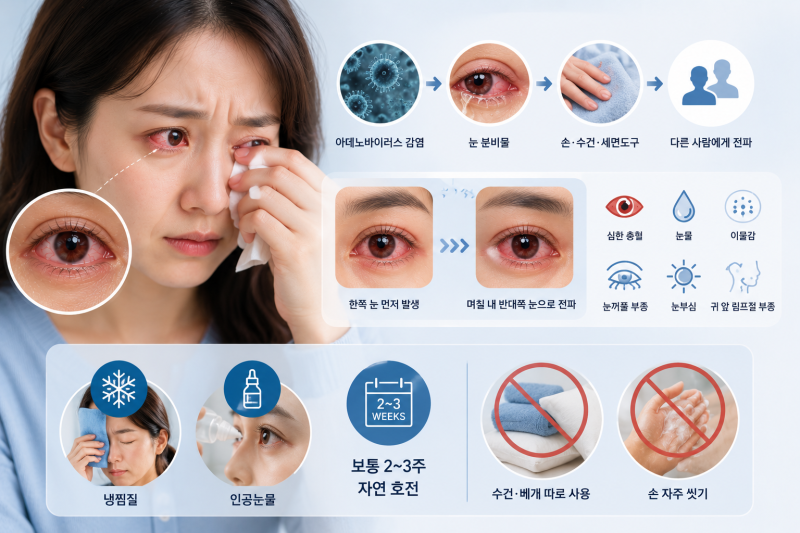
In the early stages, the most confusing distinction is between allergic conjunctivitis and epidemic keratoconjunctivitis (EKC). EKC is a highly contagious eye infection caused by adenoviruses—commonly referred to simply as "pink eye."
It spreads rapidly through infected ocular secretions, hands, towels, and shared washroom items, with symptoms typically appearing after an incubation period averaging about 7 days (KDCA). A classic pattern is that it begins in one eye and spreads to the other within a few days.
Symptoms primarily include severe redness, watery discharge, foreign body sensation, and photophobia (light sensitivity). In severe cases, eyelid swelling or swollen preauricular lymph nodes (in front of the ears) may occur. Unlike allergic conjunctivitis, itching is relatively mild.
Because there is no specific antiviral medication, treatment focuses on preventing secondary bacterial infection and managing symptoms. With cold compresses and artificial tears to reduce discomfort, it generally resolves naturally over 2 to 3 weeks. Since the disease is extremely contagious during this period, it is crucial to use separate towels and pillowcases and practice frequent handwashing.
4. How Treatments Differ for the Three Conditions
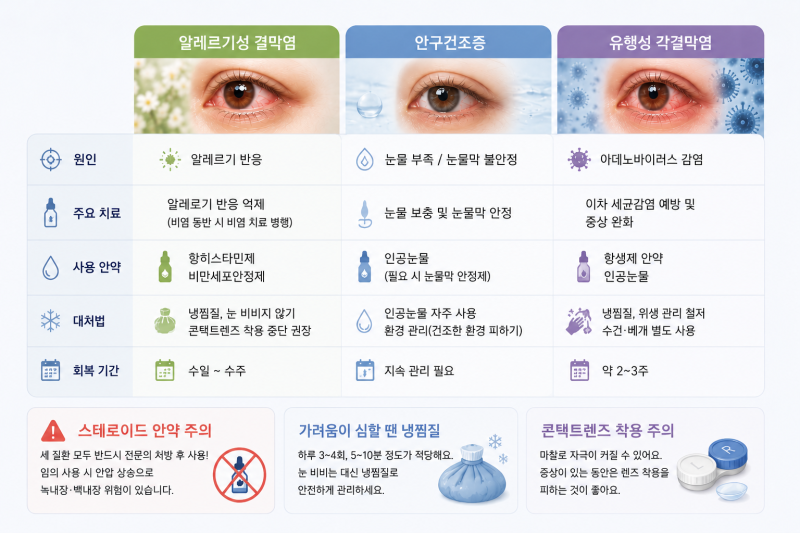
The eye drops and management approaches used for these three conditions are entirely different. Because the underlying causes differ, the treatment pathways diverge completely even if symptoms appear similar.
Allergic conjunctivitis relies primarily on antihistamine and mast cell stabilizer eye drops. Because the core goal is suppressing the allergic reaction itself, artificial tears alone may not suffice. If seasonal rhinitis is also present, managing nasal allergies concurrently helps relieve eye symptoms.
Dry eye syndrome centers on artificial tears and tear-film stabilizing therapies. Adjusting daily frequency and formulations (such as preservative-free options) to match individual eye conditions is essential.
Epidemic keratoconjunctivitis lacks a targeted antiviral agent; therefore, it is managed with antibiotic drops to prevent secondary bacterial infection, along with artificial tears and cold compresses for symptom relief while awaiting natural recovery.
Notably, steroid eye drops must only be used under the strict prescription of an ophthalmologist for all three conditions. Unsupervised use can elevate intraocular pressure, potentially leading to glaucoma or cataracts, and can progress without noticeable warning signs. Steroid-induced glaucoma rarely presents with early symptoms, meaning optic nerve damage can occur unnoticed (Korean Glaucoma Society). Because appropriate eye drops depend strictly on the underlying diagnosis despite overlapping symptoms, obtaining a proper diagnosis and prescription at an eye clinic is safest.
When itching is severe, applying cold compresses 3 to 4 times a day alongside prescribed drops is helpful. Rubbing the eyes irritates conjunctival blood vessels, aggravating redness and swelling and potentially creating micro-abrasions on the corneal surface; cold compresses serve as a safe alternative. If you wear contact lenses, friction between the lens and cornea can heighten irritation, so it is best to avoid wearing lenses while symptoms persist.
5. When You Should See an Ophthalmologist

If you experience any of the following, seek professional medical evaluation rather than self-diagnosing:
Severe redness or pain localized to only one eye (Allergic conjunctivitis typically affects both eyes; prominent unilateral symptoms suggest another underlying cause)
Severe light sensitivity (photophobia) or blurred vision
Copious or thick, sticky discharge
Symptoms lasting longer than 1 to 2 weeks
Pain following contact lens wear (Requires evaluation for corneal injury or ulceration)
Persistent stinging and itching despite regular use of artificial tears
Leaving allergic conjunctivitis untreated for long periods can lead to keratitis or corneal opacity, potentially impairing vision. If symptoms recur, establishing an accurate diagnosis early is vital.
Frequently Asked Questions (FAQ)
Q. Does itchy eyes always mean allergic conjunctivitis?
Not necessarily. Seasonal dry eye syndrome or simple external irritation can also cause itching. However, if itching is accompanied by redness, increased tearing, and eyelid swelling, an allergic reaction is highly probable. Conversely, if stinging and grittiness predominate over itching, consider dry eye syndrome first.
Q. Can artificial tears resolve the symptoms?
Artificial tears help lubricate the ocular surface and flush out irritating substances. However, if an allergic reaction is the root cause, they cannot resolve the condition entirely. If stinging and itching persist despite using artificial tears, an evaluation is needed to determine whether it is simple dryness or an overlapping allergic component.
Q. Is it safe to use over-the-counter eye drops arbitrarily?
Caution is advised. In particular, steroid-containing eye drops used without a specialist's prescription can increase intraocular pressure, raising the risk of glaucoma and cataracts. Steroid-induced glaucoma often progresses without obvious symptoms, potentially causing optic nerve damage without the patient realizing it. Even if symptoms look similar, appropriate formulations differ based on cause; getting evaluated and prescribed by an eye specialist is the safest route.
Suspecting Allergic Conjunctivitis? Visit St. Mary's Jin Eye Center

If eye itching and stinging persist despite artificial tear use, it may not be a simple dryness issue.
At St. Mary's Jin Eye Center, former clinical faculty from the Retina Division of Seoul St. Mary's Hospital provide direct consultations, accurately assessing the conjunctiva and ocular surface environment through visual acuity testing, intraocular pressure measurement, and slit-lamp biomicroscopy. Rather than offering superficial symptom relief, we comprehensively evaluate tear film stability, the corneal surface, and conjunctival reactions to pinpoint whether the issue is allergic, dry-eye related, or stemming from another etiology.
By designing personalized treatment plans tailored to each patient's lifestyle and ocular condition, we help even those with chronic, recurring seasonal discomfort resolve the root causes. If seasonal eye discomfort continues to trouble you, discover the precise cause at St. Mary's Jin Eye Center today.
Key Takeaway!
If eye itching and stinging do not improve with artificial tears, allergic conjunctivitis and dry eye syndrome may be coexisting. When symptoms recur, identifying the exact cause and receiving tailored treatment is essential.
References
Korea Disease Control and Prevention Agency (KDCA) National Health Information Portal: Allergic Conjunctivitis https://health.kdca.go.kr
Journal of the Korean Medical Association: Diagnosis and Pharmacotherapy of Allergic Conjunctivitis https://jkma.org
Journal of the Korean Ophthalmological Society https://www.ophthalmology.org
Korean Glaucoma Society https://www.koreanglaucoma.org
Asan Medical Center Health Information https://www.amc.seoul.kr