2026-11-18
Antibody Injections for Macular Degeneration and Retinal Diseases: Types Including the Latest Drug Beovu
An overview of anti-VEGF antibody injections for macular degeneration and retinal diseases, including Avastin, Lucentis, Eylea, and the newest drug, Beovu, and their safety.
Today, let's cover a somewhat more detailed and specialized topic.
Patients with macular degeneration or diabetic retinopathy are probably already aware that intravitreal antibody injections are used to treat these conditions.
All of the retinal injection drugs we will cover today are monoclonal antibodies, and their mechanism of action is the same as that of targeted anticancer drugs.
The purpose of these drugs is to suppress the abnormal neovascularization that occurs in conditions such as macular degeneration, diabetic retinopathy, retinal branch vein occlusion, and myopic choroidal neovascularization.
These drugs selectively inhibit vascular endothelial growth factor (VEGF), a key driver of neovascularization (NV), which is why they are called anti-VEGF agents.
It sounds technical, but put simply, anti-VEGF agents prevent cancer cells from forming new blood vessels, which suppresses tumor growth. This same principle is applied to neovascular diseases of the retina.
The first antibody injection used for the retina was Avastin.
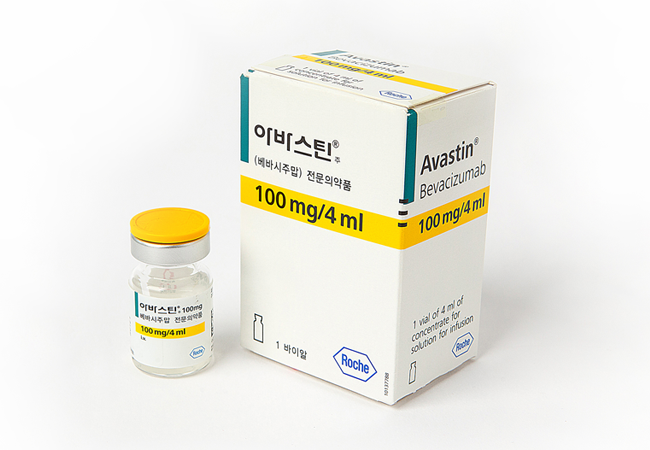
Avastin (bevacizumab) 100 mg/4 ml box and vial by Roche; the Korean label marks it as a prescription-only medicine.
This drug is used alone or in combination with other agents to treat colorectal cancer, breast cancer, non-small cell lung cancer, renal cell carcinoma, glioblastoma, ovarian cancer, peritoneal cancer, cervical cancer, and other conditions.
It was not originally developed as an ophthalmic drug; it was a systemic anticancer agent.
Numerous studies around the world have examined intravitreal injections of Avastin, and its safety and efficacy have been established.
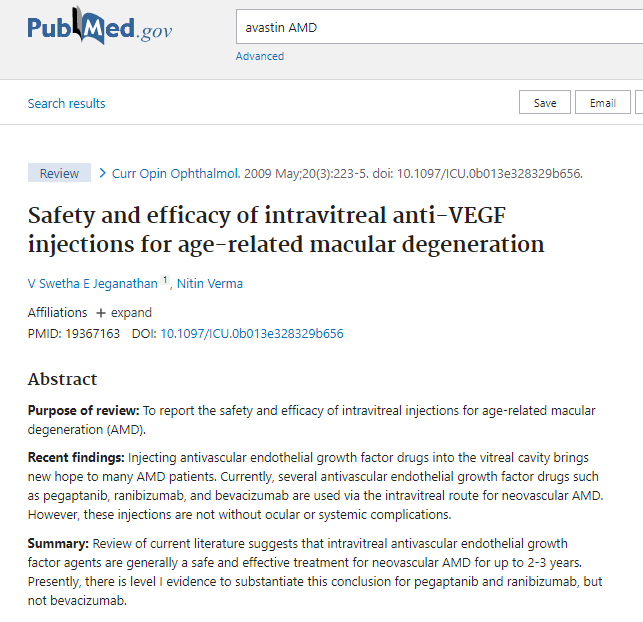
PubMed abstract (2009): a review on the safety and efficacy of anti-VEGF eye injections for age-related macular degeneration.
Later, the following drugs were developed specifically as ophthalmic agents.
They are Lucentis and Eylea.
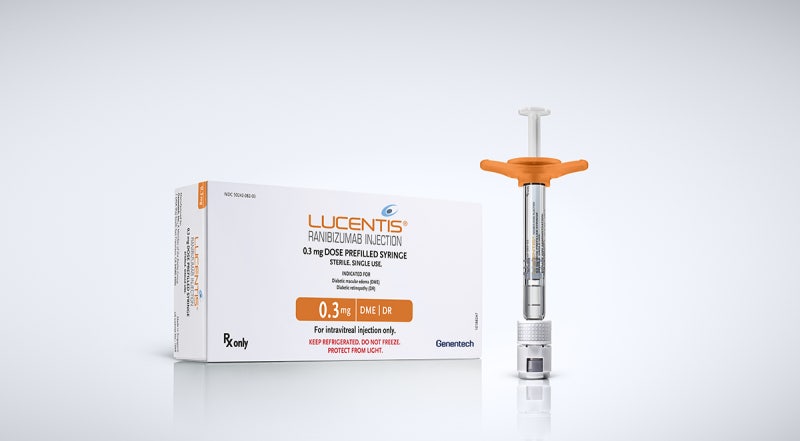
Lucentis (ranibizumab) 0.3 mg prefilled syringe and box by Genentech, labeled for intravitreal injection only.
[Lucentis]
- Generic name: Ranibizumab
- Structure: recombinant humanized IgG1 kappa isotype monoclonal antibody fragment
- Protein chemical formula: C2158H3282N562O681S12
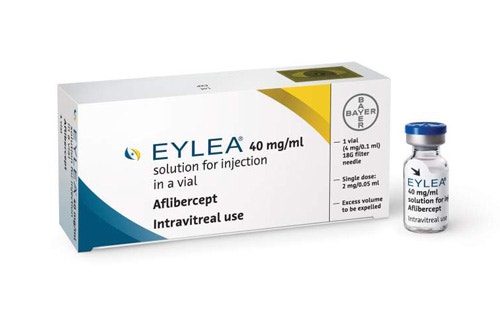
Eylea (aflibercept) 40 mg/ml box and vial by Bayer, a solution for intravitreal injection.
[Eylea]
- Generic name: Aflibercept
- Structure: recombinant dimeric glycoprotein consisting of two VEGF receptors fused with the Fc region of human immunoglobulin gamma 1 (IgG1)
- Protein chemical formula: C4318H6788N1164O1304S32

Structure comparison: ranibizumab (Fab fragment, 48 kDa), bevacizumab (full antibody, 149 kDa) and aflibercept (VEGFR–Fc, 96.6 kDa).
As the figure shows, Lucentis has the smallest molecular size.
Eylea, which has strong binding affinity, remains in the body the longest.
However, anti-VEGF agents do not always produce only beneficial effects.
Because they inhibit blood vessel formation, they may cause side effects such as ischemia or infarction if they act on normal tissue.
For this reason, studies have been conducted to determine whether these drugs cause life-threatening complications such as cerebral infarction or myocardial infarction.
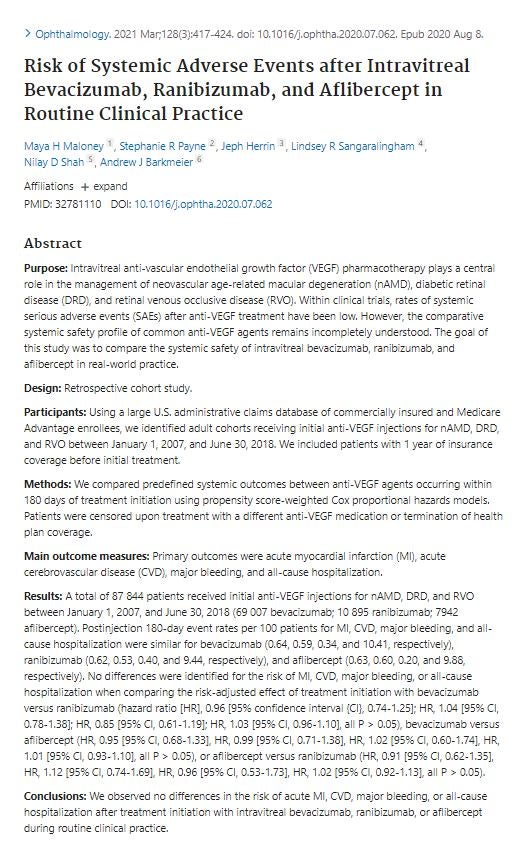
2021 study abstract on systemic side effects of bevacizumab, ranibizumab and aflibercept injections; no differences in risk were found.
Fortunately, to date, none of the three drugs has been shown to cause such fatal complications in a clinically meaningful way.
That said, it goes without saying that these drugs should be prescribed after examination by a specialist with extensive experience in retinal treatment.
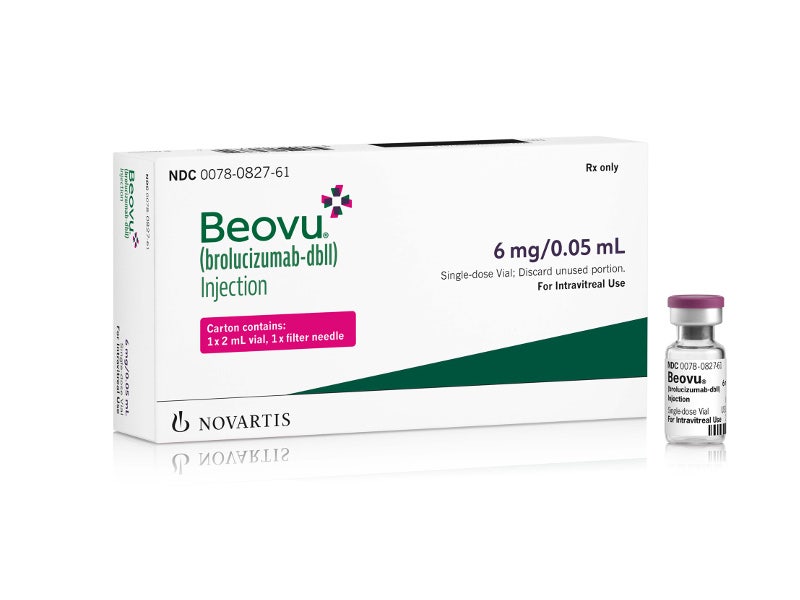
Beovu (brolucizumab) 6 mg/0.05 mL box and single-dose vial by Novartis, for intravitreal use.
The most recently released new drug is [Beovu].
- Generic name: Brolucizumab
- Structure: humanized single-chain antibody fragment (scFv)
- Molecular weight: ~26 kilodaltons
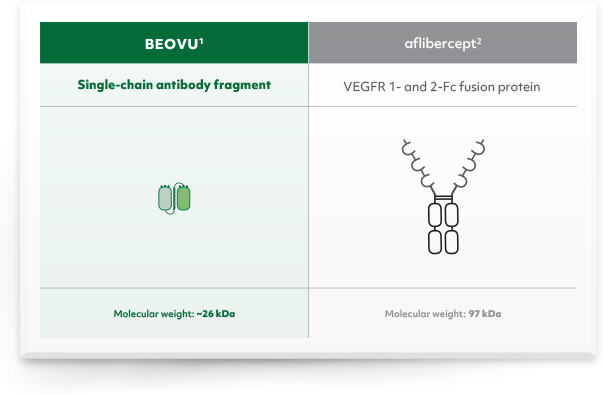
Comparison: Beovu is a single-chain antibody fragment (~26 kDa), while aflibercept is a VEGFR1/2–Fc fusion protein (97 kDa).
Beovu has the smallest molecular weight of all intravitreal antibody injections developed to date.
A smaller molecular weight means better tissue penetration.
It is also cleared quickly from systemic circulation, so it has fewer systemic side effects.
However, side effects such as retinal vasculitis have been reported, so it should be administered carefully by a specialist.
The development of new drugs for various retinal diseases expands the treatment options available to physicians, which is a welcome development.
However, as explained above, every drug has both benefits and risks, so those risks must always be kept in mind.
Therefore, appropriate prescribing tailored to each patient is essential, and that is what truly reflects a physician's skill.
For macular and retinal diseases, you can trust your care to Dr. Park Jin-hyeong, Director of Seongmo Jin Eye Clinic and an adjunct professor at Seoul St. Mary's Hospital.
For more details, please visit the clinic's website.
Today we covered a fairly complex and technical topic.
I thought many patients might be curious about the antibody injections used to treat macular degeneration and other retinal diseases, so I wrote about them.
This has been Park Jin-hyeong, Director of Seongmo Jin Eye Clinic. ^^
#Floaters #SeongmoJinEye #JinEyeClinic #MacularDegeneration #RetinalDisease #RealEyeClinic #Retina #Ophthalmology #Presbyopia #IPL #SkinCare #TotalCare #Laser #AntiAging #AntiAgingCare #Whitening #Cataract #MultifocalLens #CataractSurgery #GangnamEyeClinic #SeongmoEyeClinic #PresbyopiaSurgery #OphthalmologyProfessor #Glaucoma #DryEye #DryEyeSyndrome #DryEyes #ArtificialTears #Lens #LASIK #LASEK #GangnamLASIK #SmileLASIK #PainFreeLASEK #TodayLASEK
Frequently Asked Questions
What are the antibody injections used to treat macular degeneration?
Intravitreal antibody injections are used for retinal diseases such as macular degeneration, and their purpose is to suppress abnormal neovascularization. The article explains that they serve the same purpose for neovascularization caused by diabetic retinopathy, retinal branch vein occlusion, and myopic choroidal neovascularization.
How do anti-VEGF drugs work?
Anti-VEGF drugs selectively inhibit vascular endothelial growth factor (VEGF), a key driver of neovascularization. The article explains that this principle applies the mechanism of targeted anticancer drugs, which block cancer cells from forming new blood vessels, to retinal neovascular diseases.
How do Avastin, Lucentis, and Eylea differ?
Avastin was originally a systemic anticancer drug, while Lucentis and Eylea were later developed specifically for ophthalmic use. According to the article, Lucentis has the smallest molecular size, and Eylea, which has strong binding affinity, remains in the body the longest.
What are the features of Beovu?
Beovu is the most recently released new drug from Novartis and has the smallest molecular weight among intravitreal antibody injections developed to date. The article explains that its small size gives it good tissue penetration, and because it is cleared quickly from systemic circulation, it has fewer systemic side effects. However, side effects such as retinal vasculitis have been reported, so it must be administered carefully by a specialist.
Do antibody injections carry no risk of side effects?
It cannot be said that there are no side effects. Because these drugs inhibit blood vessel formation, they may cause side effects such as ischemia or infarction in normal tissue. However, the article notes that to date, none of the three drugs has been shown to cause fatal complications such as cerebral or myocardial infarction in a clinically meaningful way.
Who should you see for antibody injections?
It is advisable to be examined by a specialist with extensive experience in retinal treatment and to receive a prescription after that evaluation. The article stresses that every drug has both benefits and risks, so an appropriate prescription tailored to each patient is important.