2026-11-15
Uveitis That Comes Back Just When You Forget feat. Muri-nn
Explains uveitis: the uvea's anatomy, anterior, intermediate, and posterior types, infectious vs. non-infectious causes, symptoms, and treatment with immunosuppressants.
Uveitis is not a common condition.
However, people with a history of non-infectious uveitis often experience recurrences again and again, which can be very frustrating.
So what exactly is the uvea, and why does inflammation develop there?
In English, this structure is called the uvea (포도막).
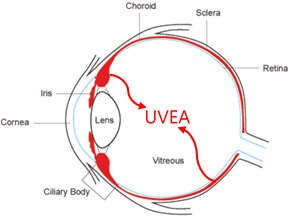
Eye anatomy diagram: the uvea (iris, ciliary body and choroid) is highlighted in red, with the cornea, lens, retina and vitreous labeled.
The red-shaded area in the eye diagram above is the uvea.
The uvea is the middle layer inside the eyeball, made up of the iris at the front, the ciliary body in the middle, and the choroid at the back.
Inflammation in this layer is called uveitis.
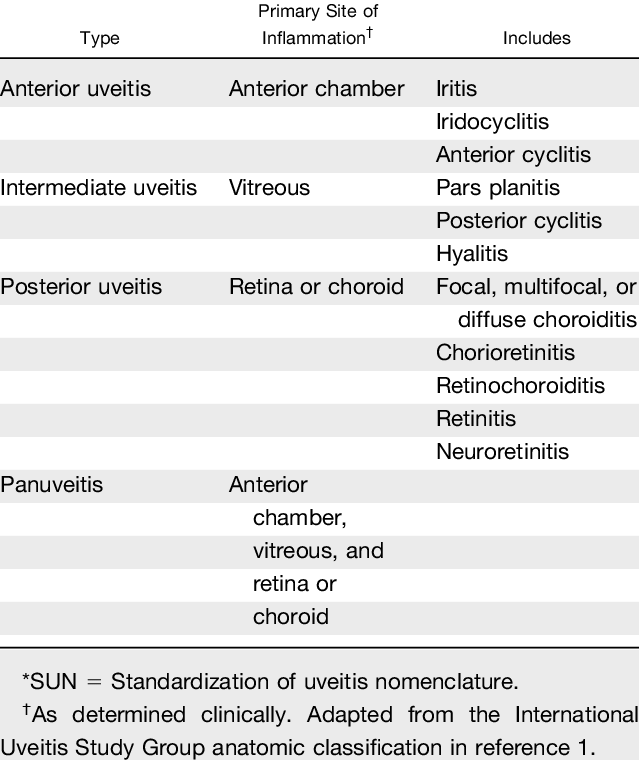
Table classifying uveitis by site: anterior (anterior chamber), intermediate (vitreous), posterior (retina/choroid) and panuveitis (all).
As the table shows, uveitis is classified by where the inflammation occurs:
Anterior – inflammation of the iris and ciliary body
Intermediate – inflammation of the vitreous
Posterior – inflammation of the retina and choroid
That is how uveitis is divided by location.
This is exactly why a dilated exam is essential for uveitis patients, so the back of the retina can be checked as well.
When inflammation is found in the anterior segment, we also need to check for inflammation in the intermediate and posterior segments.
So what causes uveitis?
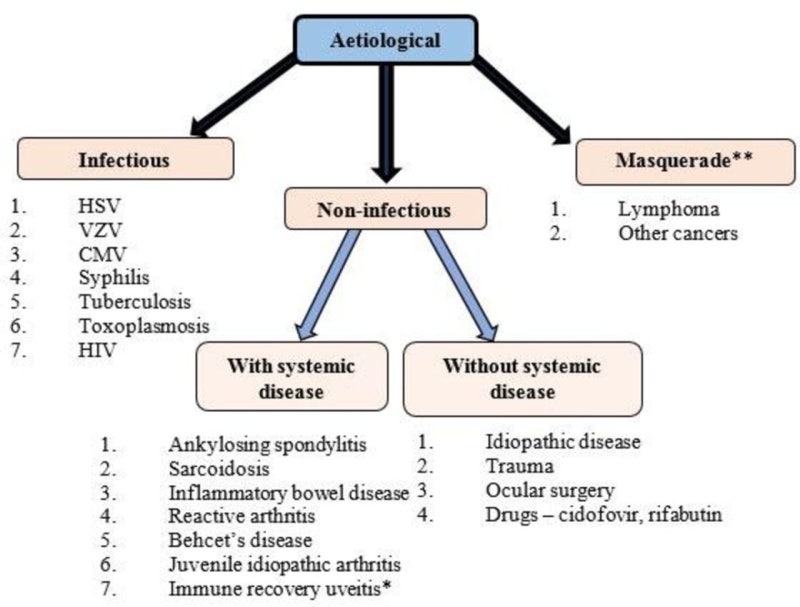
Uveitis causes chart: infectious (e.g. herpes, TB, syphilis), non-infectious (with or without systemic disease) and masquerade (e.g. lymphoma).
As this chart shows, the causes of uveitis are broadly divided into infectious and non-infectious. There is also masquerade syndrome, which is associated with lymphoma or malignant tumors.
Infectious causes include herpes, herpes zoster (shingles) virus, cytomegalovirus (CMV), syphilis, tuberculosis, toxoplasmosis, HIV, and others.
Toxoplasmosis and cytomegalovirus, for example, can be contracted by eating undercooked meat or consuming unusual foods raw.
Non-infectious causes include systemic autoimmune diseases, namely rheumatologic conditions such as ankylosing spondylitis, sarcoidosis, inflammatory bowel disease, Behçet's disease, and arthritis.
It can also be triggered by trauma, surgery, or medications.
To distinguish among these related conditions and identify any coexisting diseases, patients diagnosed with uveitis are advised to undergo a thorough internal medicine workup.
Of course, many cases of uveitis are idiopathic, occurring without any associated disease.
Non-infectious uveitis is characterized by the possibility of recurring at any time.
In other words, it can develop without any specific infectious cause.
Typical symptoms of uveitis include redness, blurred vision, and pain.
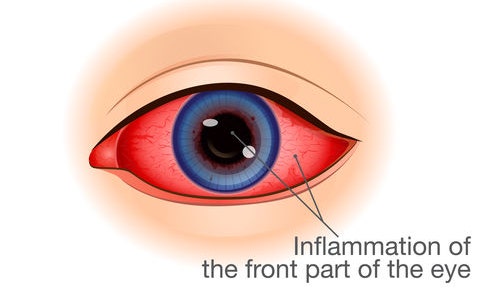
Illustration of a red, bloodshot eye labeled 'Inflammation of the front part of the eye.'
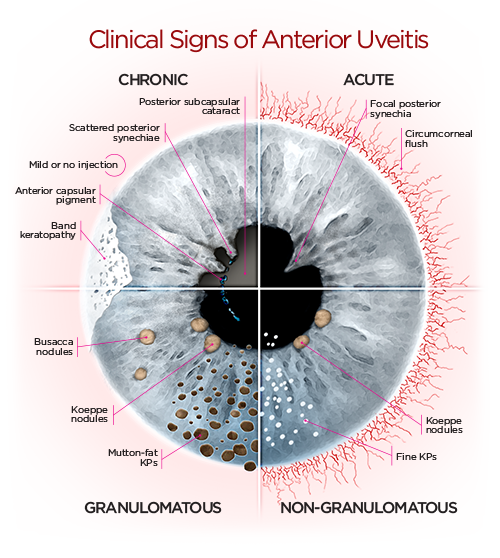
Anterior uveitis signs, chronic vs acute and granulomatous vs not: synechiae, iris nodules, KP deposits and redness around the cornea.
As the images above show, various intraocular signs can be observed under the slit lamp.
For patients with idiopathic uveitis, the same symptoms tend to reappear when the condition recurs,
so it is not uncommon for them to recognize the early signs themselves and visit the clinic.
Idiopathic uveitis is linked to a decline in overall health, such as from overwork, stress, heavy drinking, or smoking, so correcting these lifestyle habits is important.
So how is uveitis treated?
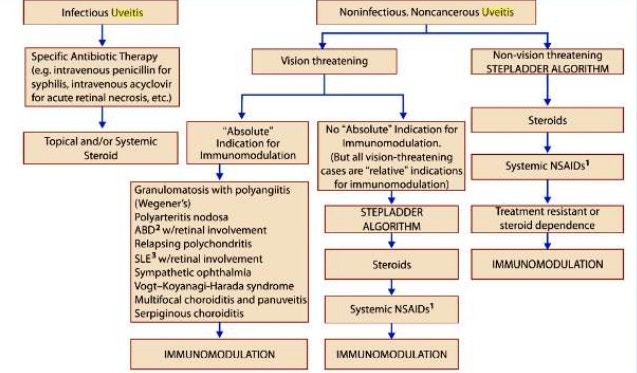
Uveitis treatment flowchart: antimicrobials plus steroids for infectious cases; steroids, NSAIDs, then immunomodulation for non-infectious.
For infectious uveitis, treating the underlying infection comes first,
while for non-infectious uveitis, the appropriate use of immunosuppressants is key.
Corticosteroids are a representative class of immunosuppressants.
They can be administered in various ways, including eye drops, oral medications, intravenous infusions, and eye injections.
There are also other immunosuppressants, such as cyclosporine.
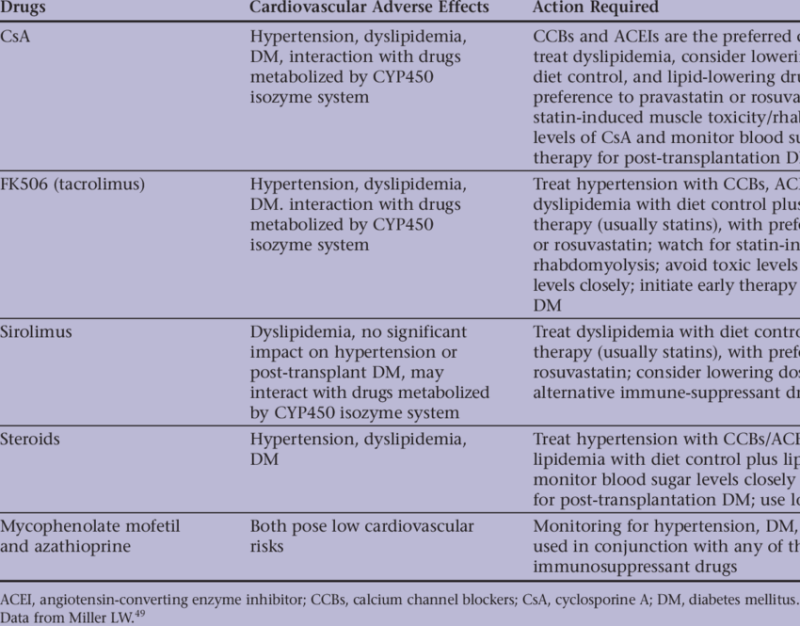
Table of immunosuppressants (cyclosporine, tacrolimus, sirolimus, steroids, etc.), their cardiovascular side effects and required actions.
Each immunosuppressant can have its own side effects, so it is important to see a specialist and receive a prescription tailored to your overall health and how you respond to the medication.
Today, we have covered the anatomical location, causes, symptoms, and treatment of uveitis.
Since this is a technical medical topic, we have tried our best to explain it as simply as possible.
Soon, we will take time to explain it again out loud on the YouTube channel [Jjin Eye Clinic].
For more details, please visit the Sungmo Jin Eye Clinic website.
For uveitis, it is important to be examined and treated by an ophthalmologist who specializes in the retina.
If you have questions about your eye condition related to uveitis, please feel free to come in anytime for a consultation with Dr. Park Jin-hyung, Chief Director of the clinic and a retina clinical fellow and outpatient professor at Seoul St. Mary's Hospital. ^^
#Uveitis #Floaters #SungmoJinEyeClinic #JinEyeClinic #MacularDegeneration #RetinalDisease #JjinEyeClinic #Retina #Ophthalmology #Presbyopia #IPL #SkinCare #TotalCare #Laser #AntiAging #AntiAgingTreatment #SkinWhitening #Cataract #MultifocalLens #CataractSurgery #GangnamEyeClinic #SungmoEyeClinic #PresbyopiaSurgery #OphthalmologyProfessor #Glaucoma #DryEye #DryEyeSyndrome #DryEyes #LASIK #LASEK #GangnamLASIK #SmileLASIK #ArtificialTears #Lens #PainFreeLASEK #TodayLASEK
Frequently Asked Questions
Is uveitis a common condition?
No, it is not a common condition. However, people with a history of non-infectious uveitis may experience recurrences several times, which can be quite distressing.
Which part of the eye is the uvea?
The uvea is the middle layer inside the eyeball, made up of the iris at the front, the ciliary body in the middle, and the choroid at the back. Inflammation that occurs in this area is called uveitis.
What are the main symptoms of uveitis?
The main symptoms are redness, blurred vision, and pain. Symptoms during a recurrence are often similar, so some patients recognize the early signs themselves and visit the clinic promptly.
How is uveitis treated?
Treatment depends on the cause. For infectious uveitis, treating the underlying infection comes first. For non-infectious uveitis, the appropriate use of immunosuppressants such as corticosteroids is important. Since each immunosuppressant can have side effects, you should consult a specialist and receive an appropriate prescription.
Why is a dilated exam performed during uveitis testing?
A dilated exam is performed to make sure the back of the retina is checked as well. When inflammation is present in the anterior segment, the intermediate and posterior segments also need to be evaluated.
Does non-infectious uveitis recur?
Yes, non-infectious uveitis can recur at any time. Idiopathic uveitis is associated with a decline in overall health from overwork, stress, heavy drinking, or smoking, so correcting these lifestyle habits is important.