2026-11-17
Types of Multifocal Intraocular Lenses: Which One Will Go in My Eye?
This article explains the three main types of intraocular lenses used in cataract surgery (monofocal, bifocal, and trifocal/multifocal) and what each one is best suited for.

As I mentioned earlier, multifocal intraocular lenses can be implanted during cataract surgery for presbyopia.
So what kinds of intraocular lenses could actually end up in my eye?
As you may have guessed, there is a huge variety of intraocular lenses on the market today.
Monofocal lenses, often called the first generation, focus on just one distance: either far or near.
There are also bifocal lenses, which add intermediate-distance vision to distance vision,
and finally trifocal lenses, which cover near, intermediate, and distance vision.
Lenses can be classified by function in this way.
Monofocal lenses, the first generation, have been around for a long time, so many manufacturers offer a wide range of versions.


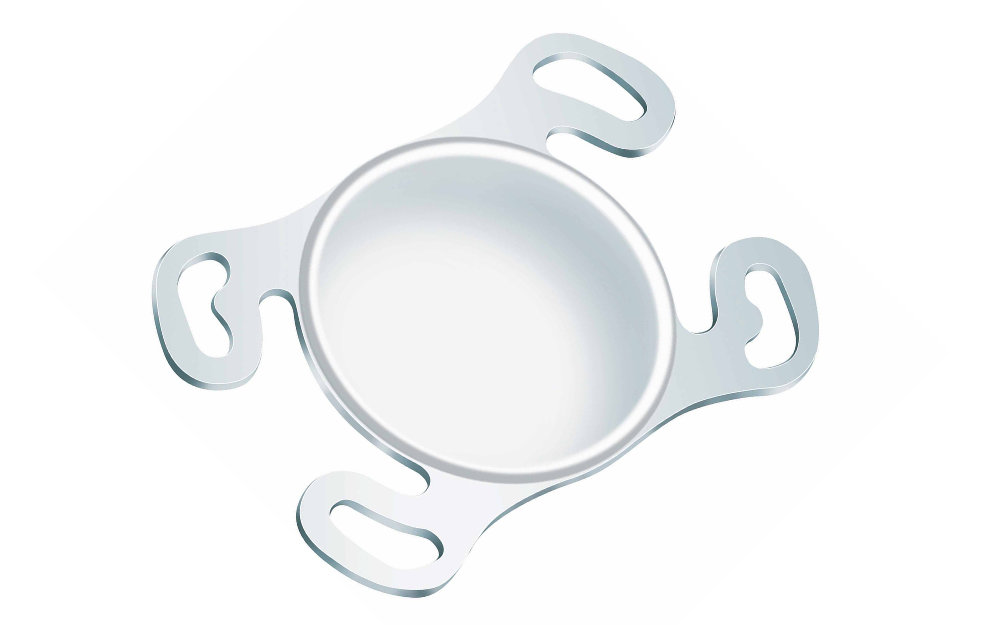
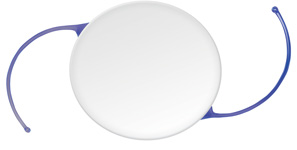

Illustration of a clear round intraocular lens with two thin, curved blue support arms.
Illustration of an intraocular lens with a round optic and four loop-shaped support arms.
Among bifocal lenses, which cover distance and intermediate vision, the Eyhance intraocular lens is a representative option and is widely used these days.
However, near-vision performance is noticeably reduced with this lens.
So this lens is used for patients whose problems lie outside the lens itself, such as corneal clouding or retinal abnormalities, and who therefore cannot be guaranteed a full 100% recovery of visual function after cataract surgery,
or for those who cannot choose a trifocal lens but still want intermediate-distance vision.

2020 study abstract: TECNIS Eyhance IOL vs a standard monofocal lens, reporting better intermediate and similar distance vision.
Finally, trifocal (multifocal) intraocular lenses offer a solution for presbyopia.

Comparison: in A the phone held in hand looks blurry, while in B the phone screen is sharp against a lakeside view.
As shown in this photo, if a monofocal intraocular lens is implanted during cataract surgery, distance vision is clear as in Image A, but near objects such as a cell phone remain blurry, just as they are with presbyopia, so reading glasses are still needed.
If a multifocal intraocular lens is implanted, both distance and near vision are clear, as in Image B, so you no longer need reading glasses.
In recent years, various types of multifocal intraocular lenses have been continuously developed.
As a result, the types and prices of these products vary widely.
At Sungmo Jin Eye Clinic, we use Alcon's Panoptix and PhysIOL's Finevision, which earn the highest patient satisfaction after surgery and are the most expensive products in terms of cost.

Defocus curves comparing visual acuity (logMAR) across distances for four lenses: PanOptix, Lisa tri, FineVision and Mplus.

2019 review abstract on measuring near and intermediate vision: near vision tested at 40 cm, intermediate at 63 or 80 cm.
For more detailed information on multifocal intraocular lenses, please visit the Sungmo Jin Eye Clinic website.
For presbyopia multifocal cataract surgery that is not assembly-line surgery,
but rather one-on-one personalized care and premium intraocular lens surgery, we look forward to welcoming you at Sungmo Jin Eye Clinic ^^
#Floaters #Ophthalmology #MacularDegeneration #RetinalDisease #RealEyeClinic #Retina #JinEyeClinic #Glaucoma #DryEye #DryEyeSyndrome #EyeDryness #LASIK #LASEK #SmileLASIK #GangnamLASIK #PainFreeLASEK #TodayLASEK #ArtificialTears #ContactLens #Presbyopia #PresbyopiaSurgery #MultifocalLens #Cataract #CataractSurgery #SungmoJinEyeClinic #SungmoEyeClinic #GangnamEyeClinic #OphthalmologyProfessor #Laser #IPL #SkinCare #TotalCare #AntiAging #AntiAgingCare #SkinWhitening
Frequently Asked Questions
What types of multifocal intraocular lenses are there?
Based on function, intraocular lenses can be divided into monofocal, bifocal, and trifocal (multifocal) types. Monofocal lenses focus on only one distance, either far or near. Bifocal lenses cover distance and intermediate vision, and trifocal lenses provide distance, intermediate, and near vision.
What is the difference between monofocal and multifocal lenses?
Monofocal lenses provide clear distance vision but blurry near vision, so reading glasses are needed. Multifocal lenses are described as providing clear distance and near vision, so reading glasses are no longer necessary.
When is a bifocal intraocular lens used?
It is used when a patient wants intermediate-distance vision but cannot be guaranteed full visual recovery after surgery due to issues such as corneal clouding or retinal abnormalities, or when a trifocal lens is not an option. However, near-vision performance is said to be significantly reduced.
How much do multifocal intraocular lenses cost?
The article states that prices of multifocal intraocular lenses vary widely depending on the product. It does not mention specific prices and directs readers to the clinic's website for more details.
Which multifocal intraocular lens products are available?
The multifocal products the clinic says it uses are Alcon's Panoptix and PhysIOL's Finevision. Eyhance is mentioned as a representative bifocal lens, and a research paper is cited showing that it improves intermediate-distance vision compared with monofocal lenses.