2026-11-08
Macular Degeneration in Young Nearsighted Patients?! "Myopic Choroidal Neovascularization"
Young adults with high myopia can develop myopic choroidal neovascularization, a condition similar to macular degeneration. Here are its symptoms, diagnosis, and treatment.
The macular degeneration most people know of is 'age-related' macular degeneration, a degenerative disease of old age closely tied to advancing age.
But did you know that macular degeneration can also occur in young people?!
Myopia is a condition in which images focus in front of the macula.
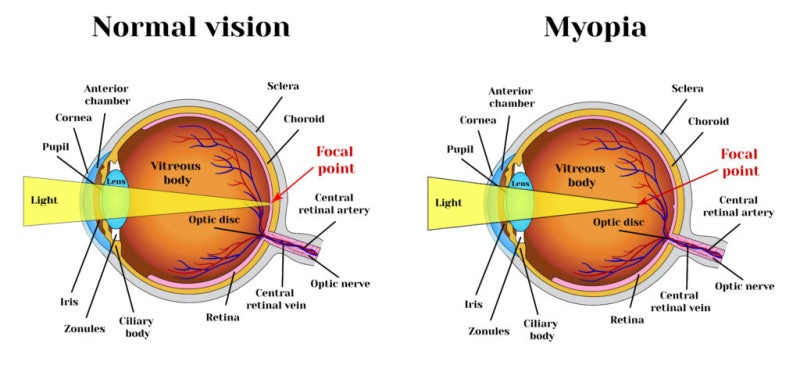
Eye diagrams comparing normal vision and myopia: light focuses on the retina in a normal eye and in front of it in a myopic eye.
The longer the eyeball, the more the focal point shifts forward relative to the retina, and the more severe the myopia becomes.
In cases of high myopia, that is, -6 D (diopters) or more with an axial length of 26 mm
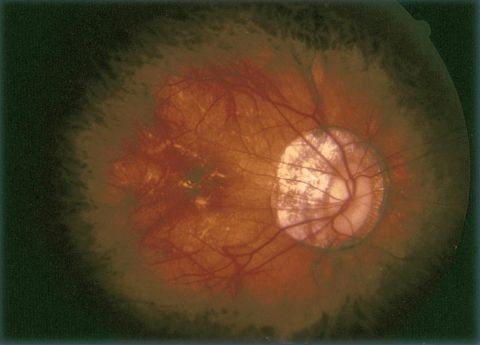
Fundus photograph of the back of the eye, showing a pale area around the optic disc and whitish changes near the macula.
There is a high likelihood of problems in the retina and choroid.
When such problems develop, the condition is defined as pathologic myopia.
The most typical complication here is the formation of choroidal neovascularization in the macular area.
This is the condition known as 'myopic choroidal neovascularization (myopic CNV).'
The mechanism by which new blood vessels form in the choroid is similar to that of macular degeneration.
The key difference is that macular degeneration is a degenerative disease caused by aging, whereas
myopic CNV can also develop in young people.
When a young patient with high myopia visits with sudden metamorphopsia (distortion, such as objects appearing bent or wavy) in one eye,
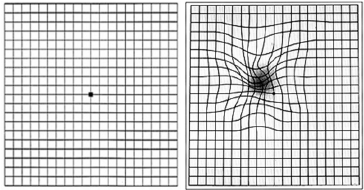
Amsler grid comparison: on the left, straight lines around a central dot; on the right, wavy lines with a dark, distorted centre.
This condition should be suspected, and examination and treatment should be carried out.
OCT results
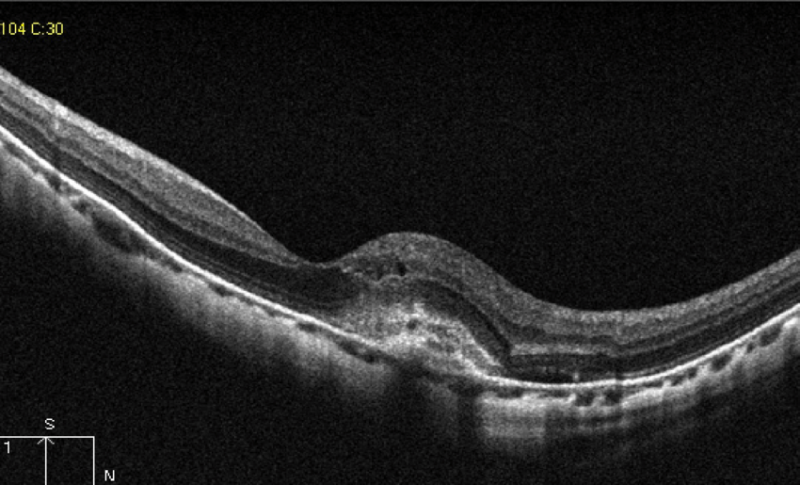
Choroidal neovascularization in the macula and retinal edema can be observed.
In such cases, intravitreal anti-VEGF injection treatment should be administered.
If you've read our posts on diabetic retinopathy and macular degeneration, these should sound familiar by now, right?
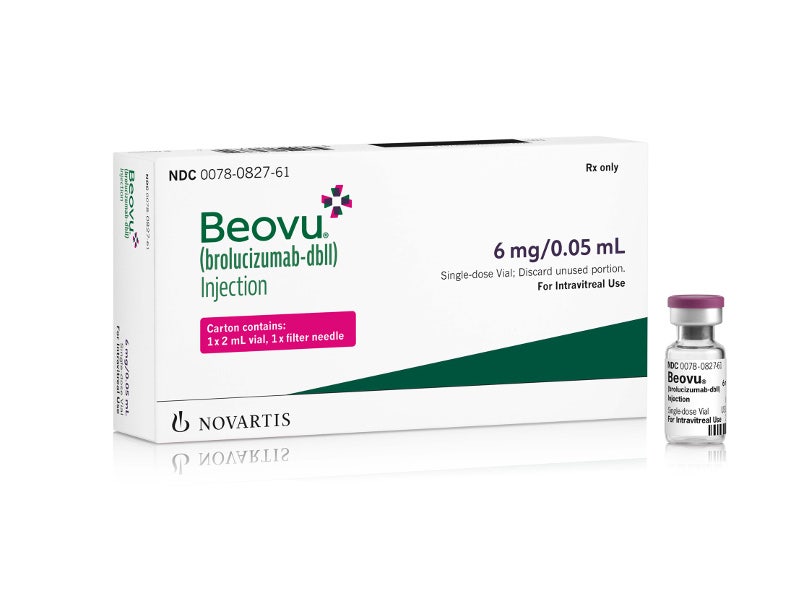
Beovu (brolucizumab) 6 mg/0.05 mL carton and vial by Novartis, labelled for intravitreal use.
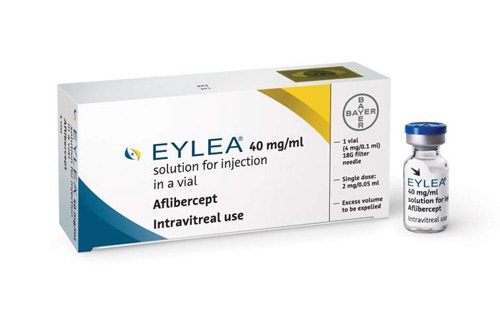
Eylea (aflibercept) 40 mg/ml carton and vial by Bayer, labelled as a solution for intravitreal injection.
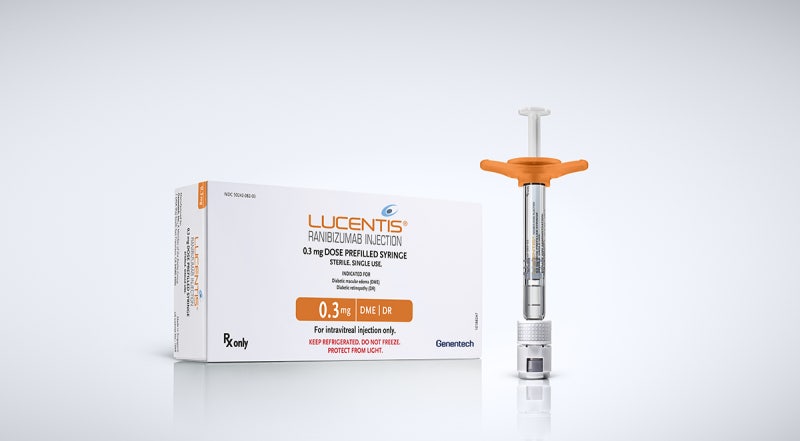
Lucentis (ranibizumab) 0.3 mg prefilled syringe and carton by Genentech, labelled for intravitreal injection only.
Yes, these are the very injections.
If you don't remember them or they're unfamiliar, please check our previous post!
Besides injections, argon laser focal photocoagulation may also be considered when the neovascular lesion lies well away from the macula.
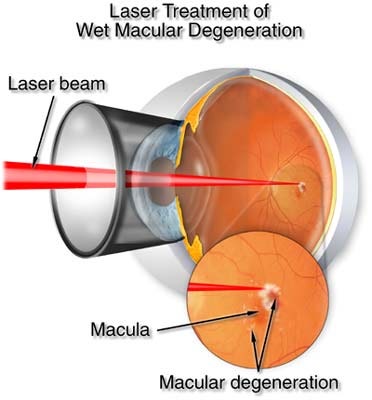
Illustration of laser treatment for wet macular degeneration: a laser beam passes through a lens to the affected macula.
Unfortunately, there is currently no specific way to prevent myopic CNV.
People with high myopia should get regular retinal check-ups at an eye clinic,
and perform the Amsler grid self-test. That's really all that can be done right now.
Seongmo Jin Eye Clinic offers specialized retinal care, equipped with the cutting-edge macular degeneration diagnostic device DRI TRITON OCT and the highest-resolution fundus imaging system EIDON FUNDUS PHOTO&FAG.
If you are nearsighted or would like a retinal check-up, feel free to visit Seongmo Jin Eye Clinic anytime ^^
#EyeClinicRecommendation #HighMyopia #Floaters #SeongmoJinEyeClinic #JinEyeClinic #MacularDegeneration #RetinalDisease #TrueEyeClinic #Retina #Ophthalmology #Presbyopia #IPL #SkinCare #TotalCare #Laser #AntiAging #AntiAgingCare #Whitening #Cataract #MultifocalLens #CataractSurgery #GangnamEyeClinic #SeongmoEyeClinic #PresbyopiaSurgery #OphthalmologyProfessor #Glaucoma #DryEye #DryEyeSyndrome #DryEyes #LASIK #LASEK #GangnamLASIK #SMILE #ArtificialTears #Lens #PainlessLASEK #TodayLASEK #Myopia
Frequently Asked Questions
Can young people develop macular degeneration?
Yes, myopic choroidal neovascularization can also develop in young people with high myopia. General macular degeneration is an age-related disease linked to aging, but the underlying mechanism is similar.
How much myopia counts as high myopia?
High myopia is described as -6 D (diopters) or more with an axial length of 26 mm. In these cases, the fundus may show peripapillary atrophy and a tigroid appearance, in which choroidal vessels are visible through the thin retina.
What are the main symptoms of myopic choroidal neovascularization?
A sudden onset of metamorphopsia in one eye, where objects appear bent or distorted, is cited as a key clue to this condition. Young patients with high myopia who present with these symptoms should be evaluated for this condition with appropriate testing and care.
How is myopic choroidal neovascularization treated?
If OCT confirms choroidal neovascularization and retinal edema in the macula, intravitreal anti-VEGF injection therapy should be given. The injectable options mentioned include Beovu, Eylea, and Lucentis. If the neovascular lesion is well away from the macula, argon laser focal photocoagulation can also be considered.
Can myopic choroidal neovascularization be prevented?
There is currently no clear way to prevent it. People with high myopia are advised to have regular retinal exams at an eye clinic and to perform the Amsler grid self-test.