2026-11-20
Black Specks Floating in Front of Your Eyes? Floaters Explained: Causes and Solutions
Black specks or gnat-like shapes drifting in your vision are called floaters. Learn why they happen, whether they need treatment, and when to see an eye doctor.
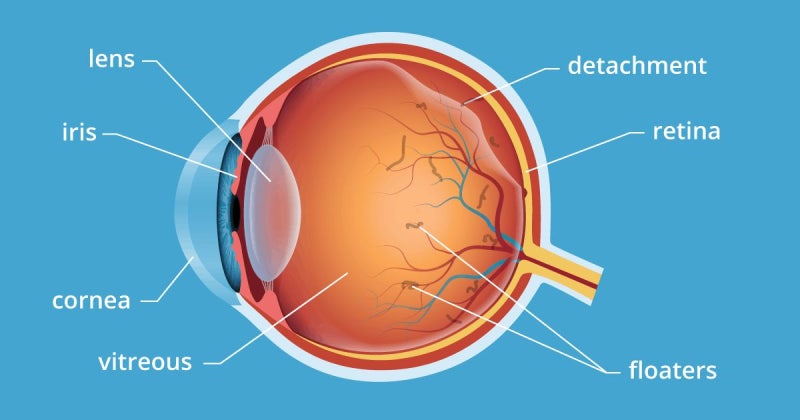
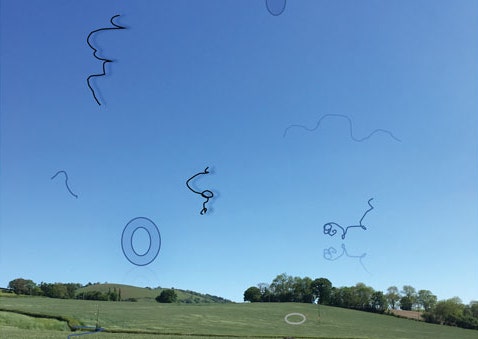
Illustration of floaters: squiggly threads and rings drifting across a view of blue sky and green fields.
“There's a swarm of black gnats flying around in front of my eyes...”

Many dark, thread-like floaters scattered across a blue sky with white clouds, as someone with floaters might see them.
“They don't go away when I rub my eyes or blink. I keep seeing them.”

Faint, see-through floater shapes drifting over a blue sky and a green hill.
“Is there any way to get rid of these?!”
In the retina outpatient clinic, we often see patients who come in with these exact complaints.
This symptom is called “nalpari-jeung” (날파리증) or “bimunjeung” (비문증) in Korean, and “floaters” in English.
So why does this happen? Is there really no way to get rid of them?
First of all, the substance filling the inside of our eyeball is mostly water, but it is not 100% water.
This filling is called the vitreous body. It is a mix of water and various connective tissue components, so in reality it has a thick, clear, jelly-like consistency.
When I explain it to patients, I sometimes describe it as having the consistency of clear nasal mucus.
Eye cross-section diagram labeling the lens, iris, cornea, vitreous, retina, floaters in the vitreous, and a detachment.
Normally, the vitreous is firmly attached to the retina, but as the illustration shows,
when posterior vitreous detachment occurs (the vitreous pulling away from the retina), either naturally or due to external impact such as trauma or eye surgery, its shadow falls onto the retina and appears as dark, flickering shapes.
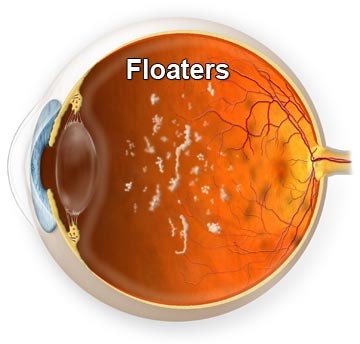
Eye cross-section labeled 'Floaters', showing small white specks scattered in the vitreous gel inside the eye.
Alternatively, with aging and other factors, the vitreous itself can become cloudy, and the resulting dark shadows can appear to flicker across the retina.
Floaters caused by posterior vitreous detachment or vitreous opacity can be resolved by removing the vitreous itself.
However, surgical removal of the vitreous is one of the largest procedures in ophthalmology, so it is not a decision to make lightly.
This is because there is a risk of developing PVR (Proliferative Vitreoretinopathy), which ophthalmologists who perform vitrectomy, a retinal surgery that removes the vitreous, call a postoperative “catastrophe.”
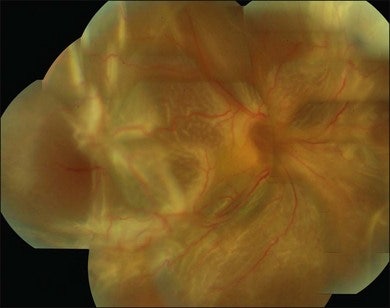
Photo of the retina at the back of the eye, showing a wrinkled, folded surface with blood vessels.
As mentioned above, simple posterior vitreous detachment or vitreous opacity is not a pathological condition, so no special treatment is needed.
So why is it important to get a dilated eye exam at an ophthalmology clinic when you develop floaters?
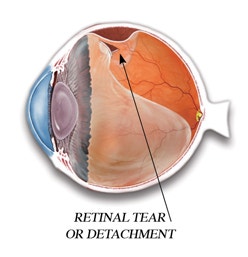
Eye cross-section labeled 'Retinal tear or detachment', showing the retina lifted away from the back wall of the eye.
As this illustration shows, in some cases the vitreous pulls away from the retina and tears the thin peripheral retina,
In other words, there is a statistical risk of a retinal tear or retinal detachment occurring alongside posterior vitreous detachment.
That's why, if you have newly developed floaters, or if the size or number of your existing floaters suddenly increases,
you should definitely get a dilated eye exam and a detailed fundus examination at an ophthalmology clinic.
Now, have your questions about floaters been answered?
For more detailed information, please visit the Seongmo Jin Eye Clinic website!
If you have concerns about your own floaters, feel free to visit us anytime for a consultation with Dr. Park Jin-hyeong, our chief physician who specializes in retina. ^^
#Floaters #SeongmoJinEyeClinic #JinEyeClinic #MacularDegeneration #RetinalDisease #TrueEyeClinic #Retina #Ophthalmology #Presbyopia #IPL #SkinCare #TotalCare #Laser #AntiAging #AntiAging #Whitening #Cataract #MultifocalLens #CataractSurgery #GangnamEyeClinic #SeongmoEyeClinic #PresbyopiaSurgery #OphthalmologyProfessor #Glaucoma #DryEye #DryEyeSyndrome #DryEyes #LASIK #LASEK #GangnamLASIK #SmileLASIK #ArtificialTears #Lens #PainlessLASEK #TodayLASEK
Frequently Asked Questions
What are floaters?
Floaters are a condition in which black dots or gnat-like specks appear to drift in front of your eyes. They are also called “nalpari-jeung” (날파리증). They are the result of shadows cast onto the retina by changes in the vitreous.
What causes floaters?
Floaters are caused by posterior vitreous detachment or vitreous opacity. Posterior vitreous detachment can occur naturally or be triggered by external impact, such as trauma or eye surgery. Vitreous opacity can occur in relation to aging and other factors.
Do floaters only go away if the vitreous is removed?
Removing the vitreous itself is described as the way to resolve floaters, but it is not an easy decision. Vitrectomy is one of the largest procedures in ophthalmology, and there is a risk of developing proliferative vitreoretinopathy (PVR) after surgery.
Do floaters always need treatment?
Not necessarily. Floaters caused by simple posterior vitreous detachment or vitreous opacity are not a pathological condition, so no special treatment is needed. However, if floaters are new or suddenly increase, you should have an eye exam.
When should I get a floaters exam?
You should get a dilated eye exam and a detailed fundus examination at an ophthalmology clinic when floaters newly appear or when the size or number of existing floaters suddenly increases. Posterior vitreous detachment can be accompanied by a peripheral retinal tear or retinal detachment, and there is a statistical risk of this occurring.